‘Forever Chemicals’ In Water & Food
PFAS Exposure In Water, Food, Everyday Items
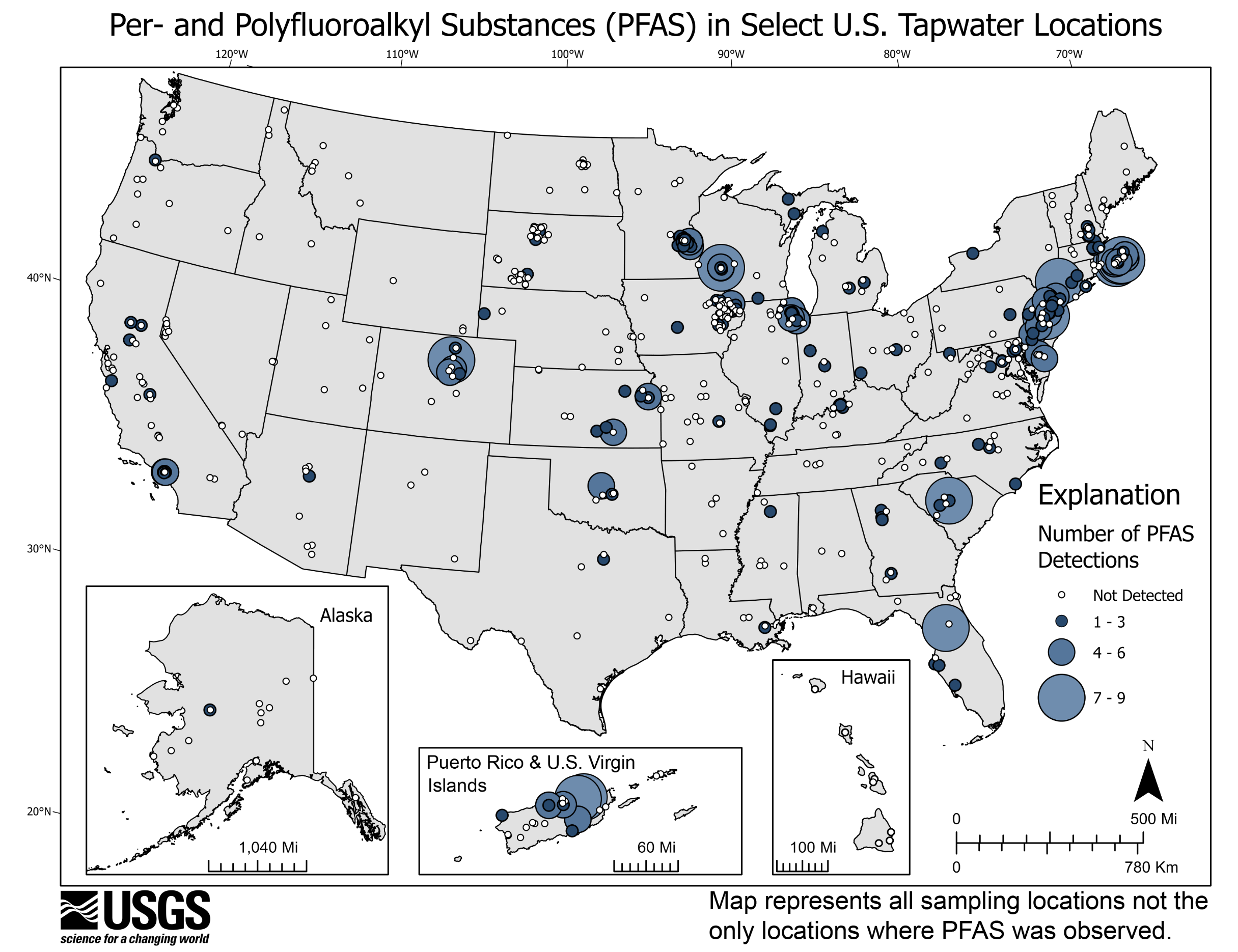
”At least 45% of the nation’s tap water is estimated to have one or more types of the chemicals known as per- and polyfluorinated alkyl substances, or PFAS, according to a new study by the U.S. Geological Survey. There are more than 12,000 types of PFAS, not all of which can be detected with current tests; the USGS study tested for the presence of 32 types”, according to USGS.gov – Office of Communications and Publishing.
The study goes on to state that drinking-water quality and its exposure to per-fluoroalkyl and poly-fluoroalkyl chemicals (PFAS) or ‘forever chemicals’, in a class consisting of thousands of substances, is a major concern in the United States and globally, due to environmental prevalence, persistence, toxicity, and human exposures through water and food.
The U.S. Geological Survey was created by an act of Congress in 1879 and provides science for a changing world, which reflects and responds to society’s continuously evolving needs. As the science arm of the Department of the Interior, the USGS brings an array of earth, water, biological, and mapping data and expertise to bear in support of decision-making on environmental, resource, and public safety issues. The USGS is a primary Federal source of science-based information on ecosystems, land use, energy and mineral resources, natural hazards, water use and availability, and updated maps and images of the Earth’s features available to the public. The U.S. Geological Survey works with many partners to provide objective and impartial science to resource managers, emergency response, and the public. Reference: USGS.gov.
USGS scientists collected water samples directly from people’s kitchen sinks across the nation, testing for 32 individual PFAS compounds in tap water from both private wells and public supplies. Scientists collected samples from 716 locations representing a range of low, medium and high human-impacted areas. The low category includes protected lands; medium includes residential and rural areas with no known PFAS sources; and high includes urban areas and locations with reported PFAS sources such as industry or waste sites. Most of the exposure was observed near urban areas and potential PFAS sources. This included the Great Plains, Great Lakes, Eastern Seaboard, and Central/Southern California regions. Because researchers were unable to test for all the PFAS chemicals considered dangerous to human health, the number of people drinking contaminated water could most likely be much higher.
PFAS or ‘Forever Chemicals’ are toxic synthetic chemicals that are resistant to decomposition through heat, water or grease and don’t break down in our bodies or in the environment. The first PFAS chemicals were produced in the early 1940’s for stain, grease and water resistant commercial products. Not only are PFAS being used in pesticides, nonstick cookware, paint, cleaning products, and firefighting foam, but also in many everyday products such as toilet paper, cosmetics, food packaging, clothing, candy wrappers, toys, dental floss, nail polish, shampoo, microwave popcorn bags, fast food packaging, pizza boxes and so much more.
Several research studies have shown that PFAS have not only been found in waterways across the country, but have polluted our soil, food products, livestock and fish. These ‘Forever Chemicals’ do not break down and are present in almost everything we use or consume. PFAS have been found in remote environments and ecosystems as well as in human blood and organs.
PFAS are harmful to human health with studies linking infertility, organ damage, cancer, thyroid disease and other health concerns in humans, by ingesting microplastics whether it be from drinking tap water, breathing in dust, cooking with non-stick cookware or eating food from contaminated soil, there are many ways humans are being exposed to these toxic chemicals.
Did we really think we could keep producing plastic and chemicals in the name of “progress” and not have any long term consequences? Look at China’s mass production of cheap products and chemical waste with no regulation or accountability and we Americans continue to buy these Chinese made products and then bury them in our Nation’s landfills. And now with the state of the economy, Americans are forced to buy more and more cheaper products from China because they cannot afford to buy products made in the U.S.
Does anyone remember when families grew their own fruits and vegetables from a rich soil free from contaminates, and used glass jars over and over again to preserve them naturally? We live in a quick, preservative induced, plastic and throw away environment, with landfills burying all this trash and their ‘forever chemicals’ in the earth. Is there any way to reverse this out of control ‘plastic’ society? Unfortunately, it doesn’t look promising.